

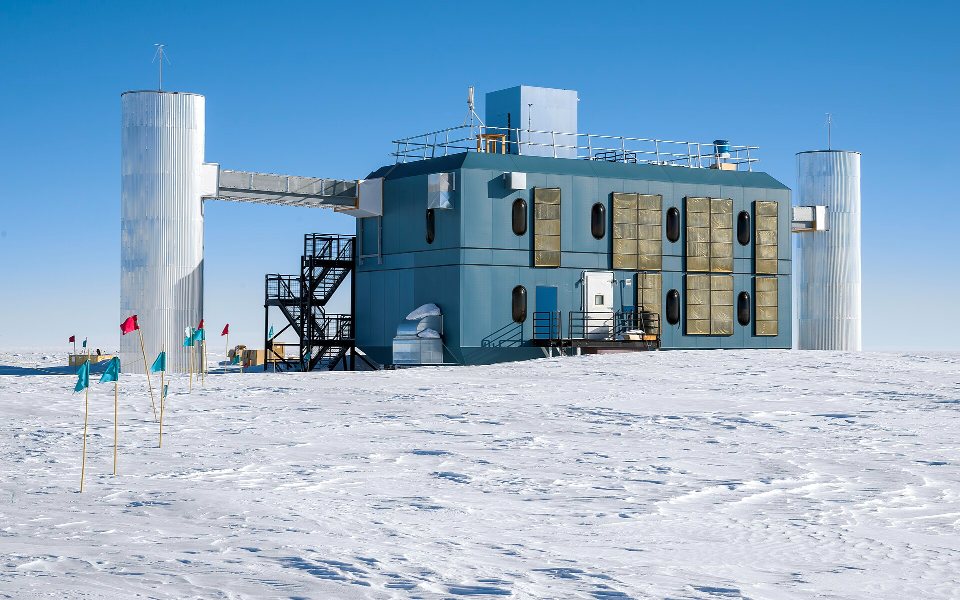
The Nobel Prize in Physics went on Tuesday, October 6, to the American physicist Francis Halzen, who led the building of a giant particle detector in the ice of the South Pole. On Wednesday, October 7, the chemistry prize went to Henri B. Kagan of France and Kenso Soai of Japan for work on “mirror” molecules.
Halzen, a professor at the University of Wisconsin-Madison, had the idea of using Antarctic ice to catch neutrinos, particles so light and elusive that almost all of them pass through the Earth without leaving a trace. The IceCube Neutrino Observatory places thousands of light sensors deep in the ice to record the faint flashes produced when a neutrino does collide with matter.
IceCube detected high-energy neutrinos coming from far outside our galaxy, opening a new way to study the universe. “His tenacity and scientific vision has paved the way for a new kind of astronomy,” said Mark Pearce, chair of the Nobel Committee for Physics.
The chemistry prize rewards a problem of “handedness.” Many molecules exist in two forms that are mirror images of each other, like a left and a right hand, and living things use only one of them. A drug's two forms can act very differently in the body.
Kagan, of Université Paris-Sud in Orsay, showed in 1986 how to produce one form in greater proportion. Soai, of Tokyo University of Science, later found a reaction that amplifies a tiny excess of one form until it produces only that form. “The chemical reactions they have developed are spectacular,” said Heiner Linke, chair of the Nobel Committee for Chemistry.
Each prize is worth 12 million Swedish crowns, about $1.2 million. The literature prize is announced on Thursday and the Peace Prize on Friday.


Comments
No comments yet. Start the conversation.