

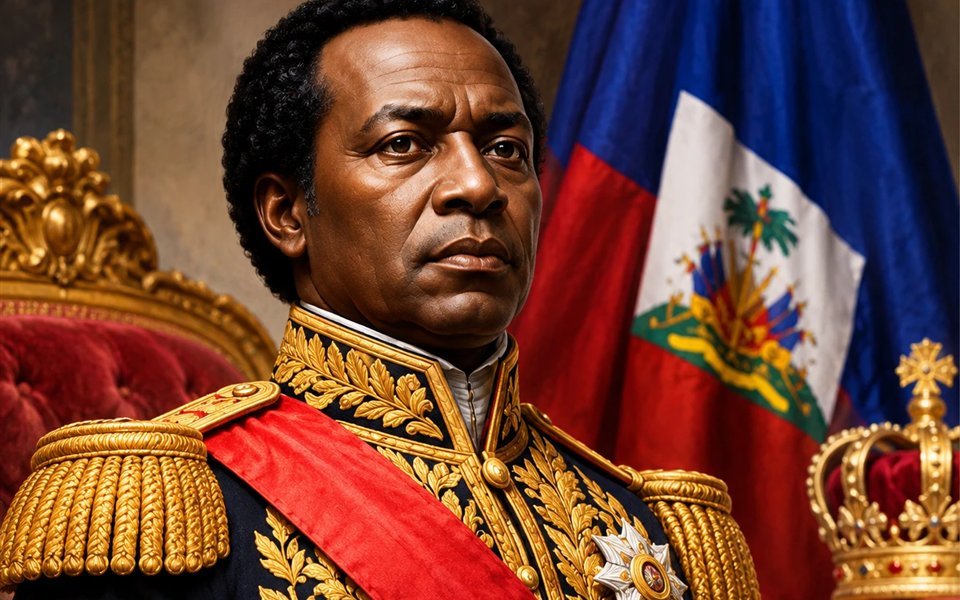
Few figures in Haitian history embody the contradictions of the nineteenth century as dramatically as Emperor Faustin Soulouque. Born into slavery in the French colony of Saint-Domingue in 1782, he lived to see a society built on human bondage become the world's first independent Black republic.
In 1849, more than four decades after Haiti declared independence, Soulouque became Emperor Faustin I, founding the Second Empire of Haiti. His reign lasted until 1859 and left a legacy of national ambition, centralized authority, political repression, military conflict and enduring debate.
Faustin-Élie Soulouque was born on August 15, 1782, in Petit-Goâve. His mother, Marie-Catherine Soulouque, was a Creole woman of Mandinka descent. He was freed by the emancipation decree of 1793, and in 1803 he joined the army fighting for independence, which Haiti won on January 1, 1804.
After independence he advanced slowly through the ranks. He became a lieutenant and aide-de-camp to General Lamarre in 1806, served in the horse guard of President Alexandre Pétion from 1810, and continued under Jean-Pierre Boyer and his successors. By the 1840s he was a general and commander of the presidential guard. A man born without freedom would become head of state.
In 1847 Haiti was deeply divided between political elites, military leaders and the rural majority. After President Jean-Baptiste Riché died, the Senate chose Soulouque as president on March 1, 1847. Some influential politicians expected a weak leader they could control.
Instead, Soulouque reorganized the military leadership, promoted loyal supporters and weakened rival factions. His government relied more and more on coercion: in April 1848 political violence in Port-au-Prince claimed many lives, and opponents were arrested, exiled or killed. Presidential power grew while the country's divisions deepened.
On August 26, 1849, the legislature proclaimed Soulouque Emperor Faustin I. Haiti had already known one empire, under Jean-Jacques Dessalines, Emperor Jacques I, from 1804 to 1806, so Soulouque's became the Second Empire. A constitution adopted on September 20, 1849, concentrated power in the emperor's hands and made the throne hereditary.
On April 18, 1852, an elaborate coronation took place in Port-au-Prince, borrowing symbols from European imperial courts. The emperor created a hereditary nobility of princes, dukes, counts and barons, along with orders of chivalry such as the Military Order of Saint Faustin. Supporters saw an assertion of national dignity; critics saw an expensive court in a time of economic hardship.
Soulouque sought to consolidate the state and protect Haiti's independence from foreign interference. He saw outside influence in the Caribbean as a threat, favored a powerful executive, and elevated Black officers and supporters against parts of the established elite. Imperial ceremony was meant to project international prestige, but it came with harsh repression, and meaningful dissent became dangerous.
The Dominican Republic had declared its independence from Haitian rule in 1844, ending the unification of Hispaniola that began in 1822. Fearing that foreign powers would use the eastern part of the island against Haiti, Soulouque launched campaigns in 1849 and in 1855–1856 to restore Haitian control.
Dominican forces resisted successfully, notably at Ocoa in 1849 and at Santomé and Sabana Larga in 1855–1856. The campaigns were costly and undermined the empire. Soulouque framed the issue as national security, but the Dominican Republic was defending its own independence, a reminder that one nation's security ambitions can threaten another's sovereignty.
His administration became increasingly authoritarian. The Zinglins, a militia associated with his rule, were linked to intimidation and violence. Personal loyalty displaced institutional accountability, while military spending and economic pressure fed discontent. His government was also associated with a comparatively open attitude toward Vodou traditions, long stigmatized by many elites.
By the late 1850s, military setbacks, financial strain and anger among political and military leaders had weakened the emperor. In December 1858, General Fabre Nicolas Geffrard, whom Soulouque himself had made Duke of Tabara, led a rebellion that spread from Gonaïves.
On January 15, 1859, Faustin I abdicated, ending the Second Empire. Geffrard became president and restored the republic. Soulouque left for exile in Jamaica aboard a British warship, returned to Haiti in 1867 and died in Petit-Goâve that August.
Soulouque remains one of Haiti's most complex figures. His rise challenged assumptions about race, class and power in the nineteenth-century Atlantic world, yet his personal advancement cannot erase the suffering caused by repression or the cost of failed military campaigns.
Some foreign portrayals of Soulouque relied on ridicule and racial caricature, and they deserve critical scrutiny. At the same time, the documented abuses of his government must not be minimized. A serious assessment should neither romanticize the empire nor reduce its ruler to the caricatures drawn by his opponents.
His story still raises hard questions. How can a nation defend its sovereignty without concentrating excessive power? How can governments address historic inequality without creating new exclusion? The strength of a nation depends not only on its leaders, but on the institutions and freedoms that outlast them.
The Second Empire disappeared in 1859, but its history remains part of Haiti's national inheritance. Haiti's history deserves more than celebration or condemnation. It deserves to be understood.







Comments
No comments yet. Start the conversation.